

Brimming with remarkable ruins, archaeological sites, and museums, Athens is a treasure trove for history buffs and culture enthusiasts. Since antiquity, this city has stood as a timeless symbol of cultural and architectural achievements, laying the foundation for Western civilizations.
Athens, the hallmark of ancient Greece, needs no introduction. Anyone who has taken basic world history classes knows about this Mediterranean city and its profound influence throughout Europe, particularly in ancient Rome. Though Greek civilization did not originate here, it reached its zenith in this city-state during the 5th century B.C. After all, many legendary figures of Western culture lived in Athens, including Aristotle, Socrates, Hippocrates, and Plato, whose legacies continue to be widely admired and studied today.
Democracy was also established in Athens during this remarkable period, granting every adult male citizen the privilege to vote. Meanwhile, the awe-inspiring temples, open-air theaters, and other impressive public structures defined the city’s grandeur. Most astonishing is the hilltop temple complex known as the Acropolis – an enduring symbol of the country’s artistic and architectural brilliance. This iconic World Heritage Site not only embodies the achievements of ancient Greece but also provides a rare glimpse into the Greek capital’s golden age.


1. Acropolis of Athens
Standing amid a bevy of tourists in central Athens, I gazed up at the most striking structure ever built by ancient Greeks that still exists today – the Acropolis – with awe and admiration. Perched on a flat-topped rocky outcrop, the “high city” was originally the royal residence of Mycenean Greek rulers for over 3,000 years. However, in 500 B.C., Athenians transformed it into a center of worship and intellectual activities, undoubtedly with the contributions of the most renowned artists, sculptors, and architects. Though fire, earthquakes, foreign invasions, and periods of neglect wore down the monumental complex, the Acropolis has proven it was built to last long.
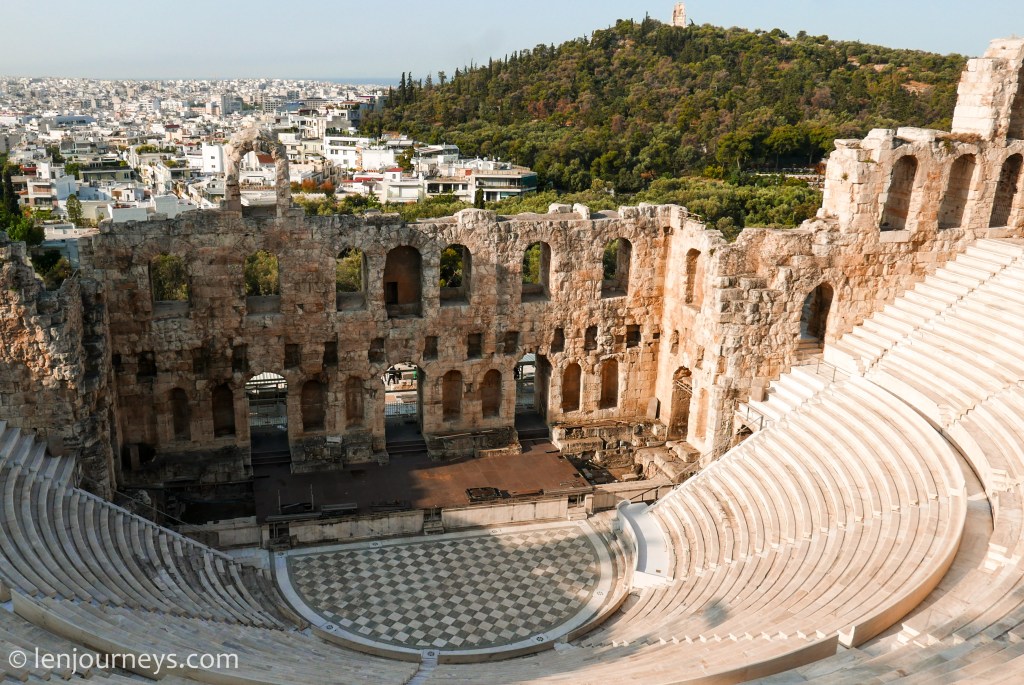
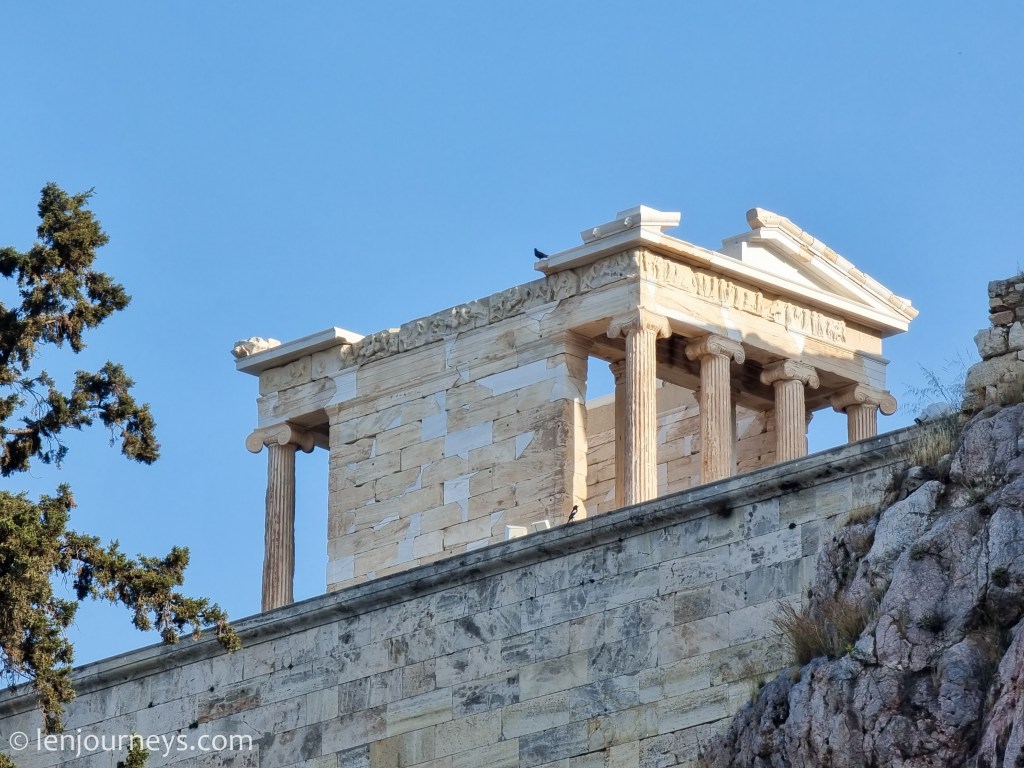
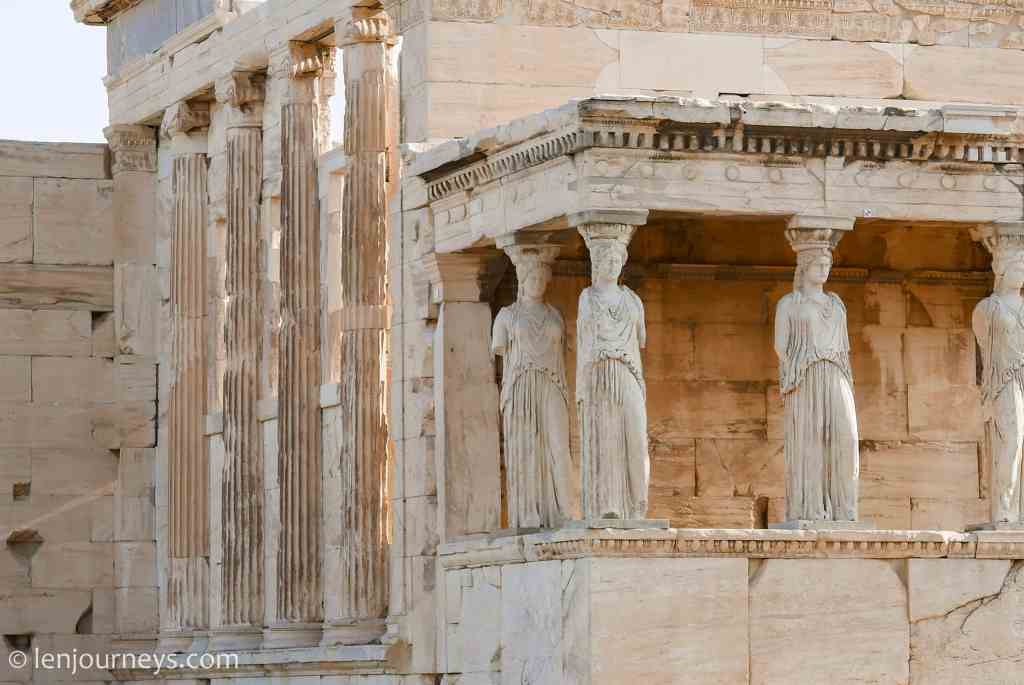
A series of unique monuments can be found across the hillsides and atop the Acropolis. These include a grand colonnade entrance, sacred shrines, and the beautiful temple of Erechtheion, alongside two spectacular open-air theaters that continued hosting performances. Yet, the crowning jewel of the whole complex is the Parthenon – a breathtaking temple constructed between 447 and 438 B.C. to honor the city’s patron deity, Athena, the Goddess of Wisdom.
The Acropolis showcases the pinnacle of ancient Greek architecture.
Though its roof has succumbed to time, the temple’s sheer size, majestic marble columns, and graceful geometric lines undeniably reflect the strength and prosperity of the ancient city-state. Later, the temple adapted to various functions, serving as a treasury, a Byzantine cathedral, an Ottoman mosque, and even a gunpowder storage facility for the Turkish army. After regaining independence from the Ottoman Empire, the Parthenon was resurrected as Greece’s most celebrated landmark. It’s also a powerful reminder of the country’s resilience, pride, and cultural heritage.



2. Acropolis Museum
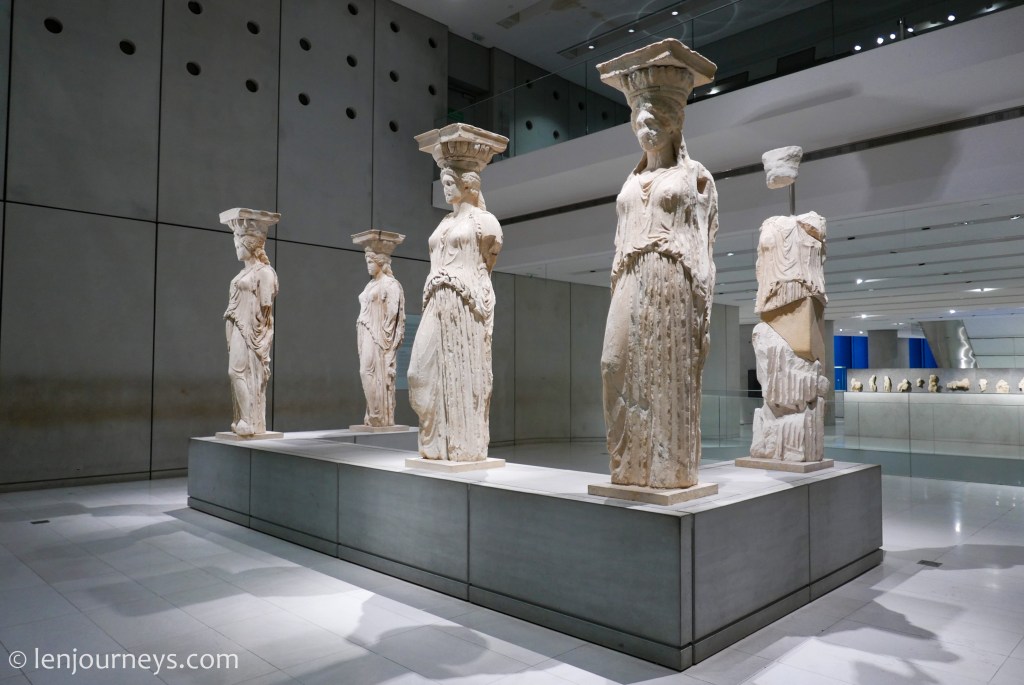
One can delve deeper into the life at the Acropolis, from its inception through the Roman and Byzantine periods, at the nearby Acropolis Museum – a sleek, modern building with grand, full-height windows that sensationally frames the ‘high city.’ Over 4,250 artifacts are thoughtfully displayed across three spacious floors, including painted pottery, ritual objects, bas-reliefs, and numerous sculptures that once graced the temple complex. Additionally, the Acropolis Museum features glass floors that allow visitors to view ongoing excavations beneath.
Some highlights include the intricate frieze from the Temple of Athena Nike, five original maiden columns or the so-called caryatid porch of the Erechtheion – a structure built to commemorate a mythological contest for Athens’ name, and the Athena Promachos – a minuscule bronze statue portraying Athena in full armor dating back to the late 5th century B.C.
Yet the most impressive is probably the Parthenon marble sculptures on the third-floor gallery. Bathed in natural light, these golden-hued masterpieces depict Greek mythology with remarkable details and artistry. They are mounted in situ, following the layout of the original temple. Interspersed among them are off-white replicas of sculptures kept in the British Museum and other foreign museums. The Greek government has made a heartfelt appeal for the return of these invaluable, but so far only a small number have been repatriated.
Delve deeper into the life at the Acropolis.




3. Ancient Agora of Athens
Traces of ancient Athens are also visible in the leafy Agora, just northwest of the Acropolis hills. It’s the finest and best-known example of a classical Greek marketplace, featuring a series of buildings around a vast square where commercial, residential, and later political and judicial gatherings happened. At its zenith, the Agora of Athens was reportedly glorious, decorated with works of art and refined marble sculptures. However, in the subsequent centuries, it faced destruction from foreign invaders, first by the Persians and later by the Romans.
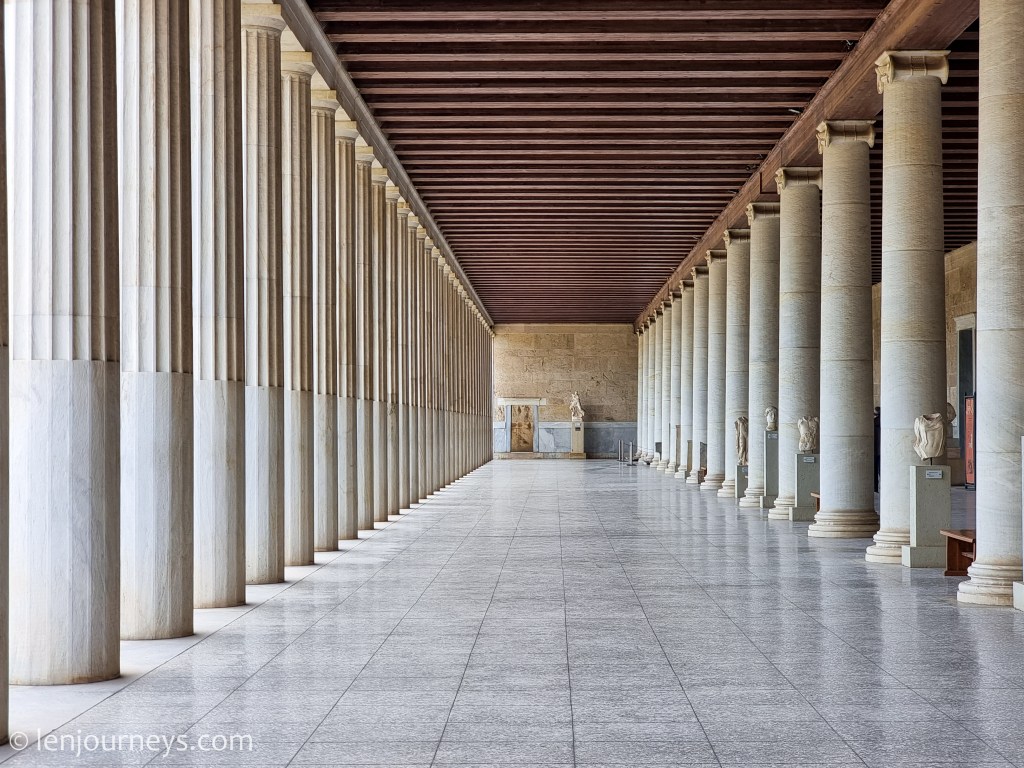
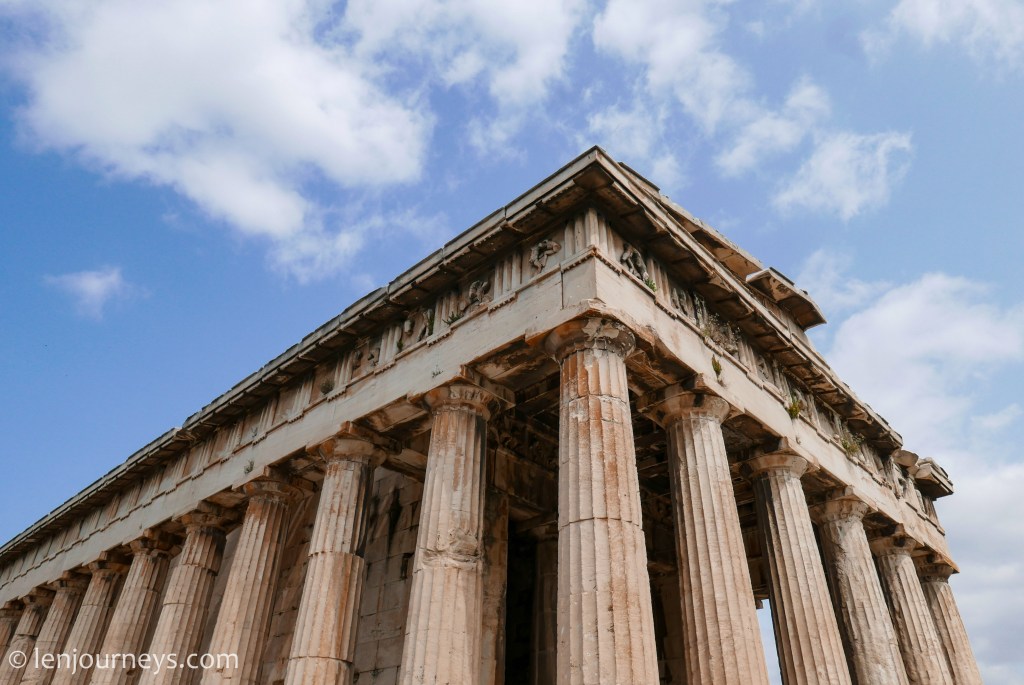
Though most buildings now lie in genteel ruins, two structures stand out in full glory: the Temple of Hephaestus and the Stoa of Attalos. The former is the best-preserved ancient temple in Greece, dedicated to Hephaestus – the mighty god of fire, metalworking, and craftsmanship. It was designed by the chief architect of the Parthenon, resulting in an almost identical appearance. Throughout history, the Temple of Hephaestus has been well maintained due to its various uses, including its role as a Greek Orthodox church from the 7th century until 1834.
Meanwhile, the Stoa of Attalos was a large shopping center established as early as the 2nd century B.C. It features two stories, with twenty-one chambers lining the walls on each floor and an elaborate facade composed of different styles of colonnades. The time-worn stoa underwent a comprehensive restoration in the 1950s and is now open as a museum that displays findings from past excavations. These include pottery, glass and bronze objects, coins, and sculptures, all of which provide valuable insights into the private and public lives of ancient Athenians.
The finest example of a classical Greek marketplace.




4. Roman Vestiges
The sun seemingly set on the democratic city in the last century B.C. when it was conquered by Roman General Sulla, following a long and brutal siege. Much of Athens was plundered, with numerous temples and structures reduced to rubble. But like a phoenix, Athens prospered again as the empire’s center of philosophy and education, where Roman scholars and elites frequented to study its teaching. The city was held in such high esteem that it earned the free-city status, which means Athens was exempted from paying taxes to Rome.
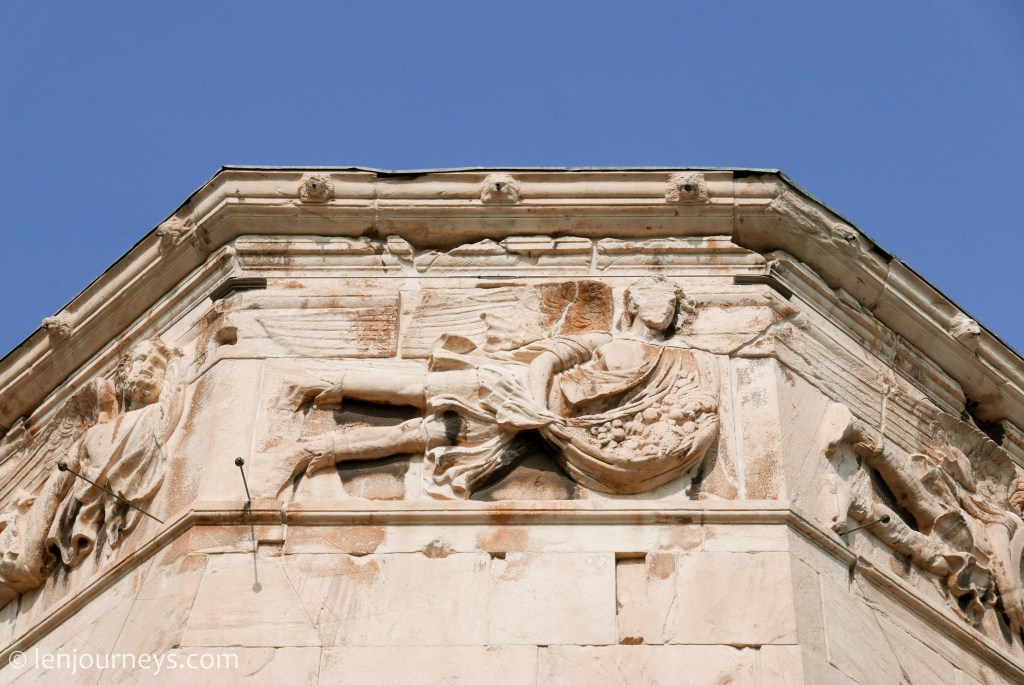
Construction was also booming in Athens under Roman rule, beginning with the Roman Agora – a large marketplace initiated by Julius Ceasar and completed by Emperor Augustus. The site is believed to have an open space surrounded by ornate marble colonnades. What stands now are some decorative fragments, several broken pillars, a well-preserved entrance gate, and the mysterious yet intricately carved clock tower named the Tower of Wind.
Nearly two centuries later, Emperor Hadrian – a fan of Athens – adorned the city with more constructions, including a library, a gymnasium, an aqueduct, a bridge, and several temples and sanctuaries. He also financed the completion of the Temple of Olympian Zeus, which later became the center of a new quarter named after him. Due to Hadrian’s contribution to Athens, a lofty arch called the Arch of Hadrian was erected to celebrate his visit to the city in 132.
However, Roman interest and cultural involvement in Athens gradually declined as the chaos of the 3rd century crept in. The empire was in disarray, and Athens increasingly came under the influence of Constantinople. Furthermore, as Christianity gained the upper hand against pagan religious beliefs, the prestigious schools of Athens lost their relevance and were eventually shut down by Justinian I in 529. This marked the end of Athens’ historical significance in the Roman era, reducing the city to a mere provincial town centered around classical monuments.


5. National Archaeological Museum
To gain a more comprehensive view of Greek art and history, I headed north to my next destination – the National Archeological Museum. Established in the 19th century, this impressive neoclassical building was initially designed to house artifacts from Athens and its surroundings. Over time, however, its collection expanded to include discoveries from throughout the ancient Greek world, including from the Ptolemaic era in Egypt. Today, the museum boasts the world’s finest and most extensive exhibition of Greek antiquities, with more than 11,000 exhibits dating from prehistory to the classical period. They are thoughtfully arranged into five main collections: prehistoric antiques, vases and minor arts, exquisite metalworks, sculptures, and Egyptian artifacts.
With dozens of halls on each floor, the museum’s vast collections deserve hours of exploration. Among these treasures, I am particularly impressed by the Prehistoric exhibition. They showcase masterpieces from the Aegean civilizations, including Cycladic and Mycenaean works that reflect their connection to the ancient Minoans. Another notable exhibition is the Stathatos Collection, which features around 900 remarkable craftworks donated by Greek art collector Eleni Stathatou in 1957. They are organized in a cohesive geographic and typological arrangement, illustrating the continuity of Greek art across time. Each artifact is individually beautiful, yet collectively, they are mind-blowing.


Tips for Visiting Athens
- The Acropolis is the most prominent attraction in the Greek capital, attracting over 22,000 visitors daily. Due to this sheer volume of visitors, authorities have implemented crowd control measures, including a time-slot system and a limit on the maximum number of visitors per day. Hence, to ensure entry, purchasing the ticket online in advance is necessary.
- The combo ticket costs €30 and grants access to the Acropolis and five other sites, including the Ancient Agora, the Roman Agora, and the Hadrian Library, for five days.
- To make the most of your visit, plan to arrive at opening time or later in the afternoon. This strategy helps you avoid the large tour groups and the sweltering midday heat, as shade is scarce on the Acropolis hill.
- A separate ticket is required to enter the Acropolis Museum. It’s also highly popular, thus getting the ticket online is highly recommended. The opening hours might extend to late at night on several days in the year.
- The National Archaeological Museum is easily accessible by bus and trolley (Polytechneio station). Alternatively, you can take the tram or metro to Omonia or Victoria station; the latter is closer to the museum.


This is the second post on the Parthenon that I came across in two days. Coincidence? Maybe. But I like to see it as a reminder for me to plan a trip to Greece sooner than later. Have you watched the opening ceremony of the 2004 Olympics in Athens? I think that’s when I became really interested in Greek history. And thank you for sharing about the National Archaeological Museum as well. I wonder if it was less crowded than the Parthenon Museum. Your photos of the Parthenon and the Erechtheion are beautiful!
Maybe it’s a sign that you should visit the temple before it becomes unbearable 😛 The tour groups rarely visited the National Archeological Museum. So it will be less crowded than the Acropolis Museum, except for the Mycenae room. But security is quite strict. You can only bring your phone and camera (compact or small DSLR) inside.
I just had a look at the opening parade of the Olympic Athens. Brilliant! The whole history of Greece was recreated. I wonder whether the white fragments floating around were the Parthenon sculptures. Thanks for letting me know about this video, Bama 🙂
You’re welcome, Len! Those white fragments are initially one big piece of head inspired by the Cycladic art. It then breaks apart in many pieces revealing a kouros inside from the Archaic Period. It then disintegrates from which emerges a depiction of a man from the classical period, itself also disintegrates. All the pieces then float on the water symbolizing the Greek islands. The visual storytelling was just so poetic and unlike anything I had ever watched.
That’s nice. Thanks for the explanation. I have to re-watch that video 🙂
Lovely photos. On my list. Might need to move it up.
Thank you, Marie! Athens is definitely worth a visit.
Your photos as always are stunning!
Thanks a lot, Anna 🙂 I’m glad you like the post.
A great summary of the sites and histories of Athens. I’ll save a link for reference for a future trip. Maggie
Thanks for visiting, Maggie! Athens is worth spending a few days (avoid the summer if possible 🙂 ). Many tourists just hit the Acropolis and head to the islands. But I think that doesn’t do justice to the Greek capital.
An enjoyable read, accompanied by your marvellous photos, that brought back wonderful memories of our visit to Athens a few years back. We loved Greece.
Alison
I remember you were in Athens a few months before my visit. And thanks to you, I knew about the Dionysus entrance, which was less crowded than the main one 🙂